Why Treatment-Room Professionals Are Standardizing on Pure Jojoba
A practical guide for clinics, tattoo studios, and bodywork therapists
Every professional who works with skin for a living eventually arrives at the same question: what goes on the client? In a treatment room, the product touching the skin is not a detail — it is part of the service, part of the result, and part of the reputation. A massage that ends in a greasy film, a facial that leaves a client broken out, or a fresh tattoo that reacts badly to an aftercare product all undo good work in an instant.
For a growing number of clinics, studios, and therapists, the answer to that question is the same: 100% pure jojoba. Not a blend, not a refined commodity oil, but first-press jojoba sourced directly from the people who grow it. This article explains what jojoba actually is, why its behavior on skin makes it so well suited to professional use, and what to look for when you bring it into your practice.
What jojoba actually is — and why it behaves differently
Although it is universally called “jojoba oil,” jojoba is not technically an oil at all. It is a liquid wax ester pressed from the seed of the Simmondsia chinensis shrub. That distinction is not pedantry; it is the entire reason the material performs the way it does.
The wax esters in jojoba are remarkably close in structure to sebum, the substance human skin produces naturally to protect and condition itself. Because the molecule the skin encounters resembles something it already makes, jojoba is recognized rather than resisted. It absorbs quickly, sits light on the surface, and does not leave the heavy, occlusive residue that many vegetable oils do. In practical terms, that means a product that conditions without suffocating the skin and without leaving your client — or your treatment table — coated in grease.
A few properties matter especially in a professional setting:
Non-comedogenic. Pure jojoba does not clog pores, which makes it appropriate for facial work and for clients who are prone to breakouts.
Suitable across skin types and ages. Because it mimics the skin’s own oil, it is generally well tolerated by dry, oily, mature, sensitive, and combination skin alike, and it is gentle enough to be used on delicate skin.
Lightweight and fast-absorbing. It conditions the skin without a slick finish, which clients notice immediately.
Naturally low scent. Pure jojoba has only a faint, neutral aroma, so it does not compete with the essential oils, aromatherapy, or fragrance-free protocols you may already use.
Long, stable shelf life. Unlike many botanical oils that oxidize and turn rancid within months, jojoba is exceptionally stable, which makes it a sensible material to buy in professional quantities.
These are not marketing flourishes. They are the day-to-day reasons jojoba earns a permanent place on the shelf once a professional tries it.
Massage and bodywork: glide without the grease
For massage therapists, the trade-off has always been glide versus cleanup. Heavier oils and butters give you the slip you need for long strokes, but they linger on the skin, soak into linens, and leave clients reaching for a towel before they leave. Lighter products absorb cleanly but disappear too fast to work with.
Jojoba sits in a genuinely useful middle ground. It provides enough slip for effective bodywork, then absorbs into the skin rather than pooling on top of it. Clients leave feeling conditioned instead of coated, and many therapists find it integrates well with their existing aromatherapy blends precisely because its own scent is so neutral.
There is also a real operational benefit. Because jojoba does not oxidize the way polyunsaturated oils do, it is far less likely to leave the rancid, set-in stains on sheets and towels that shorten the life of your linens. Professionals who have fought that battle understand immediately why a stable wax ester is worth the switch. Jojoba has also become a favorite medium for specialized modalities such as heated stone and salt stone work, where a clean, conditioning finish complements the treatment rather than fighting it.
Skincare clinics and esthetics: a versatile, low-reaction staple
In a skincare practice, predictability is everything. You need products you can use confidently across a wide range of clients without worrying that the next person in the chair will react. Pure jojoba’s non-comedogenic, sebum-compatible profile makes it a dependable workhorse: a facial conditioning oil, a cleansing and makeup-removal step, a barrier-supporting finish, and a carrier for active or essential ingredients all in one bottle.
Estheticians frequently report that jojoba suits clients who struggle with everything else — those with sensitive, reactive, or compromised skin who cannot tolerate fragranced or heavily formulated products. Because the material is so simple and so close to the skin’s own chemistry, there is very little for the skin to object to. For a clinic, that translates into fewer reactions, fewer awkward conversations, and more confidence recommending a single, clean product to take home.
That last point is worth dwelling on. A pure, professional-grade jojoba is not only a back-bar material; it is a retail opportunity. When a client experiences the result in your chair and asks what you used, being able to sell them the same authentic product extends your service and adds a revenue stream with almost no added complexity.
Tattoo studios: simple, clean aftercare and skin prep
Tattoo artists and their clients have become far more discerning about aftercare, and for good reason. Freshly tattooed skin is healing skin, and the products applied to it should be as simple and as low-reaction as possible. Heavily fragranced balms, petroleum-based ointments, and products with long ingredient lists give the skin more to react to at exactly the moment it can least afford it.
Pure jojoba offers an appealingly minimal alternative. Its lightweight, conditioning, low-scent profile makes it a natural fit for keeping healing skin comfortable and moisturized without the greasy, occlusive feel of traditional aftercare products. Studios also value it as a clean conditioning option for the skin in general, and as a retail item to send clients home with — a single, honest product they can trust on fresh ink, rather than a drawer full of half-used tubes.
For an industry that increasingly markets itself on cleanliness, natural ingredients, and care, a 100% pure botanical with a transparent origin story is an easy fit for the brand as much as for the skin.
The detail professionals overlook: purity and sourcing
Here is where many professionals get caught out. Jojoba is widely available, but not all jojoba is equal, and the differences are invisible on the label. A great deal of commodity jojoba is sourced from multiple origins, blended, and refined primarily to hit a price point. Refining strips away character and can introduce processing steps that defeat the very reasons you chose a natural material in the first place.
First-press jojoba is a different proposition entirely. Pressing only the best of the seed, and doing so without the aggressive refining used to maximize yield, preserves the naturally light feel, the quick absorption, and the faint, clean scent that make the material so well suited to treatment-room work. The result is a product that performs the way professionals expect every single time.
Origin matters just as much as grade. A vertically integrated producer — one that grows, harvests, presses, and bottles from a single source rather than buying on the open market — can stand behind the consistency and purity of every batch because there is no middleman and no anonymous supply chain. For a professional staking their reputation on what touches a client’s skin, that traceability is not a luxury. It is the foundation of trust.
Why Treatment-Room Professionals Are Standardizing on Pure Jojoba
Practical considerations for buying at professional volume
Bringing jojoba into a practice is straightforward, but a few choices are worth making deliberately:
Golden versus clear. Unrefined golden jojoba carries a faint natural scent and color, while a clear, deodorized version is virtually scent- and color-free — useful when you want a completely neutral medium or a clean base for your own blends.
Conventional versus certified organic. If your brand leans into organic and clean-beauty positioning, a certified organic option lets your back bar match your marketing.
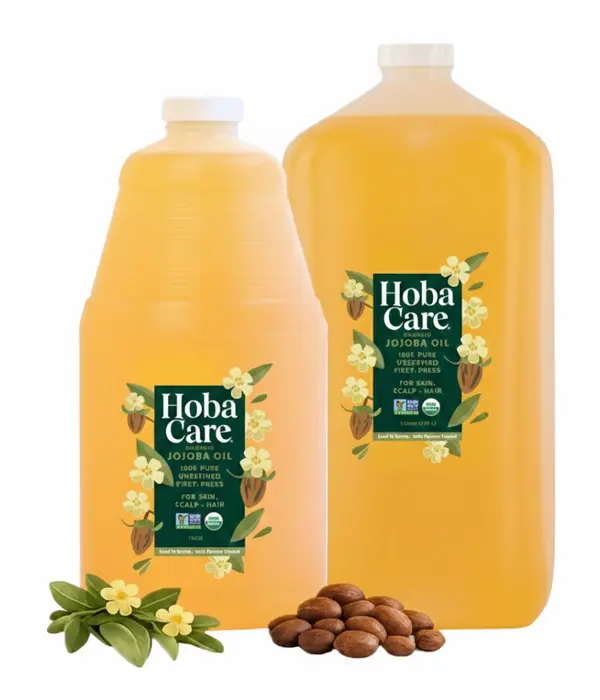
Size and format. Professional and high-volume users can move from retail bottles to gallons, pails, and drums, which lowers cost per use and reduces packaging waste — a meaningful consideration for sustainability-minded practices.
Storage and handling. Jojoba’s stability gives it an exceptionally long shelf life, so buying in bulk is low-risk. Store it sensibly, and be aware that pure jojoba can solidify in cold conditions and simply returns to liquid at room temperature — a sign of purity, not a defect.
Your brand, their jojoba
For clinics and studios ready to take the relationship further, private-label and white-label programs make it possible to retail premium jojoba under your own name. You get a proven, professional-grade product with your branding on the bottle, your clients get an authentic take-home, and you build equity in your own label rather than someone else’s.
The bottom line
A treatment-room professional needs products that are predictable, versatile, clean, and easy to stand behind. Pure first-press jojoba delivers on all four. It conditions without grease, suits nearly every skin type, plays well with your existing protocols, stores for the long term, and — when sourced directly from the grower — comes with a transparency that protects both your clients and your reputation.
For massage therapists, estheticians, clinics, and tattoo studios alike, that combination is why a simple liquid wax ester from a desert shrub keeps earning its permanent place on the professional shelf.



Why Treatment-Room Professionals Are Standardizing on Pure Jojoba
A practical guide for clinics, tattoo studios, and bodywork therapists
Every professional who works with skin for a living eventually arrives at the same question: what goes on the client? In a treatment room, the product touching the skin is not a detail — it is part of the service, part of the result, and part of the reputation. A massage that ends in a greasy film, a facial that leaves a client broken out, or a fresh tattoo that reacts badly to an aftercare product all undo good work in an instant.
For a growing number of clinics, studios, and therapists, the answer to that question is the same: 100% pure jojoba. Not a blend, not a refined commodity oil, but first-press jojoba sourced directly from the people who grow it. This article explains what jojoba actually is, why its behavior on skin makes it so well suited to professional use, and what to look for when you bring it into your practice.
What jojoba actually is — and why it behaves differently
Although it is universally called “jojoba oil,” jojoba is not technically an oil at all. It is a liquid wax ester pressed from the seed of the Simmondsia chinensis shrub. That distinction is not pedantry; it is the entire reason the material performs the way it does.
The wax esters in jojoba are remarkably close in structure to sebum, the substance human skin produces naturally to protect and condition itself. Because the molecule the skin encounters resembles something it already makes, jojoba is recognized rather than resisted. It absorbs quickly, sits light on the surface, and does not leave the heavy, occlusive residue that many vegetable oils do. In practical terms, that means a product that conditions without suffocating the skin and without leaving your client — or your treatment table — coated in grease.
A few properties matter especially in a professional setting:
These are not marketing flourishes. They are the day-to-day reasons jojoba earns a permanent place on the shelf once a professional tries it.
Massage and bodywork: glide without the grease
For massage therapists, the trade-off has always been glide versus cleanup. Heavier oils and butters give you the slip you need for long strokes, but they linger on the skin, soak into linens, and leave clients reaching for a towel before they leave. Lighter products absorb cleanly but disappear too fast to work with.
Jojoba sits in a genuinely useful middle ground. It provides enough slip for effective bodywork, then absorbs into the skin rather than pooling on top of it. Clients leave feeling conditioned instead of coated, and many therapists find it integrates well with their existing aromatherapy blends precisely because its own scent is so neutral.
There is also a real operational benefit. Because jojoba does not oxidize the way polyunsaturated oils do, it is far less likely to leave the rancid, set-in stains on sheets and towels that shorten the life of your linens. Professionals who have fought that battle understand immediately why a stable wax ester is worth the switch. Jojoba has also become a favorite medium for specialized modalities such as heated stone and salt stone work, where a clean, conditioning finish complements the treatment rather than fighting it.
Skincare clinics and esthetics: a versatile, low-reaction staple
In a skincare practice, predictability is everything. You need products you can use confidently across a wide range of clients without worrying that the next person in the chair will react. Pure jojoba’s non-comedogenic, sebum-compatible profile makes it a dependable workhorse: a facial conditioning oil, a cleansing and makeup-removal step, a barrier-supporting finish, and a carrier for active or essential ingredients all in one bottle.
Estheticians frequently report that jojoba suits clients who struggle with everything else — those with sensitive, reactive, or compromised skin who cannot tolerate fragranced or heavily formulated products. Because the material is so simple and so close to the skin’s own chemistry, there is very little for the skin to object to. For a clinic, that translates into fewer reactions, fewer awkward conversations, and more confidence recommending a single, clean product to take home.
That last point is worth dwelling on. A pure, professional-grade jojoba is not only a back-bar material; it is a retail opportunity. When a client experiences the result in your chair and asks what you used, being able to sell them the same authentic product extends your service and adds a revenue stream with almost no added complexity.
Tattoo studios: simple, clean aftercare and skin prep
Tattoo artists and their clients have become far more discerning about aftercare, and for good reason. Freshly tattooed skin is healing skin, and the products applied to it should be as simple and as low-reaction as possible. Heavily fragranced balms, petroleum-based ointments, and products with long ingredient lists give the skin more to react to at exactly the moment it can least afford it.
Pure jojoba offers an appealingly minimal alternative. Its lightweight, conditioning, low-scent profile makes it a natural fit for keeping healing skin comfortable and moisturized without the greasy, occlusive feel of traditional aftercare products. Studios also value it as a clean conditioning option for the skin in general, and as a retail item to send clients home with — a single, honest product they can trust on fresh ink, rather than a drawer full of half-used tubes.
For an industry that increasingly markets itself on cleanliness, natural ingredients, and care, a 100% pure botanical with a transparent origin story is an easy fit for the brand as much as for the skin.
The detail professionals overlook: purity and sourcing
Here is where many professionals get caught out. Jojoba is widely available, but not all jojoba is equal, and the differences are invisible on the label. A great deal of commodity jojoba is sourced from multiple origins, blended, and refined primarily to hit a price point. Refining strips away character and can introduce processing steps that defeat the very reasons you chose a natural material in the first place.
First-press jojoba is a different proposition entirely. Pressing only the best of the seed, and doing so without the aggressive refining used to maximize yield, preserves the naturally light feel, the quick absorption, and the faint, clean scent that make the material so well suited to treatment-room work. The result is a product that performs the way professionals expect every single time.
Origin matters just as much as grade. A vertically integrated producer — one that grows, harvests, presses, and bottles from a single source rather than buying on the open market — can stand behind the consistency and purity of every batch because there is no middleman and no anonymous supply chain. For a professional staking their reputation on what touches a client’s skin, that traceability is not a luxury. It is the foundation of trust.
Practical considerations for buying at professional volume
Bringing jojoba into a practice is straightforward, but a few choices are worth making deliberately:
Your brand, their jojoba
For clinics and studios ready to take the relationship further, private-label and white-label programs make it possible to retail premium jojoba under your own name. You get a proven, professional-grade product with your branding on the bottle, your clients get an authentic take-home, and you build equity in your own label rather than someone else’s.
The bottom line
A treatment-room professional needs products that are predictable, versatile, clean, and easy to stand behind. Pure first-press jojoba delivers on all four. It conditions without grease, suits nearly every skin type, plays well with your existing protocols, stores for the long term, and — when sourced directly from the grower — comes with a transparency that protects both your clients and your reputation.
For massage therapists, estheticians, clinics, and tattoo studios alike, that combination is why a simple liquid wax ester from a desert shrub keeps earning its permanent place on the professional shelf.
Share this article to your friends and colleague...